A theory on how to get better at making games
THE MOUNTAIN IN QUESTION#
It’s been over 4 months since I started my new job, and I’m starting to feel the urge to return to personal projects again. And I want to get better at making games.
I’ve been thinking a lot about how I could go about this. Making games is hard. To me, game development involves four pillars, each o’ them mammoth: design, art, engineering and business. Four pillars that go as deep as you allow them to go. People often spend their entire career mastering a subset of a subset of one of the four (hard surface environment artists, level designers, rendering engineers, executive producers), and you could spend your whole life pursuing that and nothing else.
To get ‘better’ at game dev in its entirety is a big undertaking. It’s a goal that’s complex and hard to pin down.
PREVIOUS, ADJACENT MOUNTAINS#
When I was 14, I learnt Rush’s The Spirit of Radio from an official transcription, paying attention to every single note Neil Peart played.
A few years later, I transcribed Steve Gadd’s Crazy Army over one summer for my audition to Berklee.
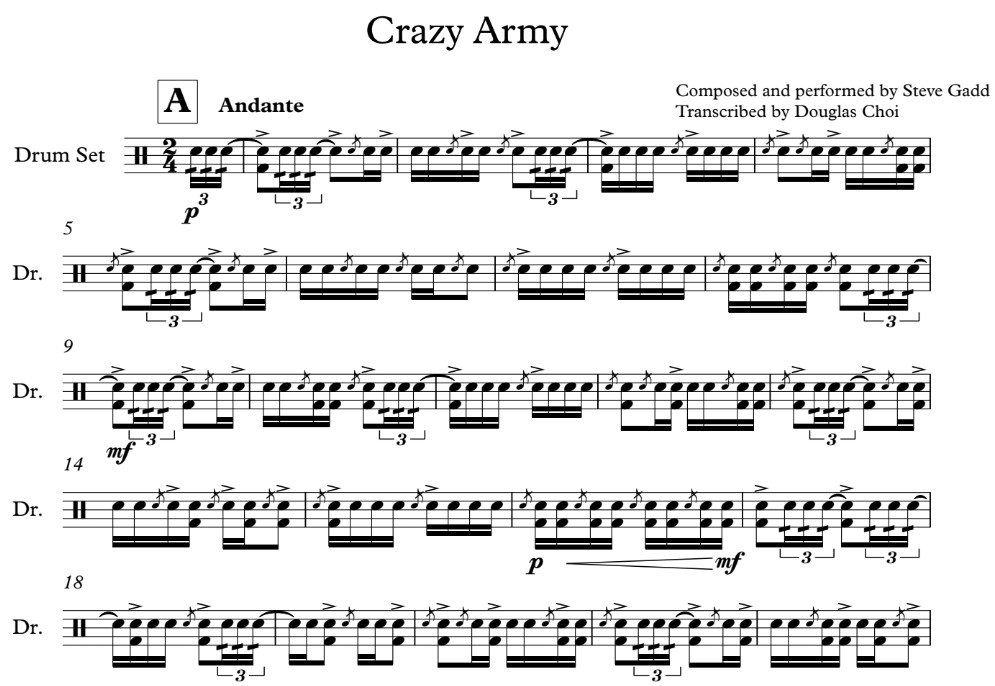
Learning these pieces with precision, and transcribing many other ones (Law from Richard Spaven, One Month from Mark Guiliana, Vordhosbn from Aphex Twin etc.) undoubtedly shaped me as a musician. Looking back on who I decided to dedicate the time to study is a good indication of my aesthetic - it’s a journal of me developing my taste. Transcribing requires a laser beam of focused attention. What you glean from the deep attention, and who you choose to focus your laser of attention on, is a reflection of who you are.
Existing transcriptions vs. creating your own
I think there’s a difference between learning a transcription that someone else has already done, and transcribing something yourself. It seems subtle from the onset, but if you’ve done both you’ll feel the difference. In animation it’s the difference between understanding a walk cycle through the formula of contact, down, pass, up or copying animation from the masters (thinking of the 9 old men as an easy example here, but all the contemporaries! Mielgo, Baxter… the list goes on); versus framing through footage and seeing beyond that directly from life, seeing the nuance first hand and interpreting it through your own lens you’ve shaped thorugh life.
Both are important! The first is faster in achieving an acceptable result - critical when starting out and learning - and is crucial in understanding your craft in relation to the rest of the canon. The latter is where the deep learning and personal expression resides (this is ironic, but true).
The idea in jazz is that you study motifs, patterns, phrases, beautiful bits of music, and internalise them until they become part of your unconcious vocabulary. So when it comes time to play, you trust yourself to make the best decision and they naturally come up in response to what you’re hearing. (I learnt this from Mark Guiliana a long time ago and whole-heartedly agree with it).
BACK TO OUR MOUNT. EVEREST#
I think this is the same with games - when it comes time to make a game, when working on an idea, I’ll be able to pull from these bits that I’ve internalised them to quickly form that idea.
I’ve seen this in other people who are far better at making games than me; once an idea has taken shape, regardless of the idea, they’ll be able to put together a prototype quickly while simultaneously making intuitive design choices along the way that push fun.
So - this theory, if you haven’t guessed by now, is to transcribe video games! Much like copying a jazz solo note for note - I want to recreate specific features, aesthetics, moments in video games, as accurately as possible.
I heard on an art podcast with Lee White that he believes a master study of a painting is only successful if the copy is indistinguishable from the original. I don’t think this is ever truly possible, nor do I think that is the best use of time, but I don’t believe the desination is the point; striving for precision and perfection is where your voice comes out.
I likely won’t look for identical replication for every single pixel and line of code e.g. I won’t go out of my way to mimic a voice actor’s accent and intonation exactly. Instead, before starting a study I’ll decide what it is I want to learn from that specific game, and focus my attention there. Maybe one or two things.
WHICH MASTERS TO LOOT?#
I’m looking for games that:
- are highly regarded
- will concretely make me learn something new
- is something just within the realms of possibility in terms of difficulty
- is something that appeals to my taste.
The Wikipedia page of games listed among the best was the first place I looked.
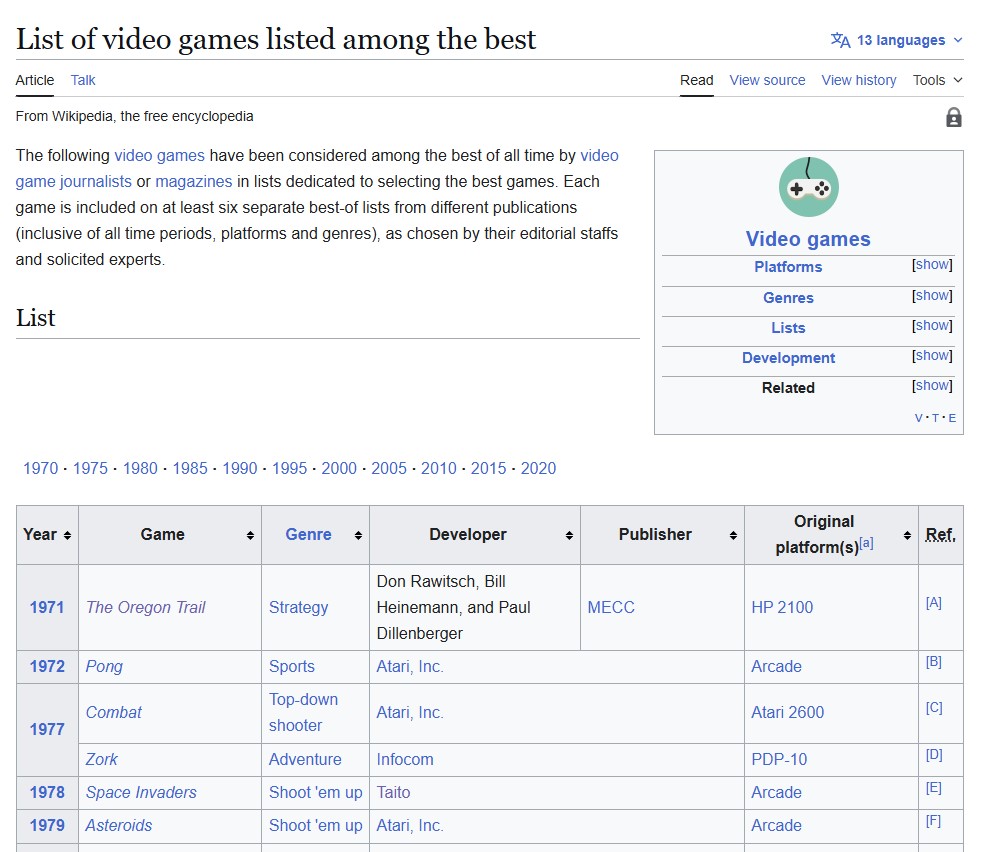
Working through these chronologically will also be a great education on games history and technology, and the fact that The Oregon Trail was developed in 1971 means that in 2026 it should be possible for anyone with any computer to recreate it. Important to note too that this list skews mainstream and fairly western, so this list should not be the be all, end all. But a good place to start.
Another list that caught my eye is The Polaris 2025 List - the aggregate of a survey of 167 professional game designers, asking them the following question: “What are the top 10 games that most influenced or inspired you as a game designer (in any order)?”. You can read more about their methodology on their website.
Finally, three games that are my favourites and I know I certainly want to study intently - Tunic, Dredge and Tactical Breach Wizards. I’ve already spent a chunk of time studying the isometric camera and targeting system of Tunic.
METHODOLOGY#
It’ll be important to set time limits on these studies too. I’ll try bringing some of the production things I’m learning from work into these. Dailies, sprints, and deliverables. I’ll also focus more on enginneering and design to begin with.
I’ll be avoiding learning new software from scratch wherever I can help it. Even though Godot is very tempting and the darling of the indie world at the moment and I love open source software, I use Unreal at work and I want to get better at it.
I’ll use Blender instead of Maya, even though I’m far faster at working in Maya, I feel like Blender is a better fully fledged 3d authoring app (texturing, sculpting, I MUCH prefer rigging in Blender, etc). Also, again - my studio uses Blender and I want to get better at it. I’m not picking something completely new like 3Dcoat, even though it’s an interesting piece of software that I want to explore when I have the time.
I’ll share the fruits of my studying, when I find time to do some!
POSTSCRIPT#
I’ve been working on this post for a while now, for over two months! It’s also coincided with me re-organising this website and cleaning it up a bit. I’m much happier with how the site looks now. I looked to the format of Tom Francis’ website a fair amount as a reference, it’s excellent.
I’ve got a big move coming up, from Bristol to Guildford! We’re still looking for a place, but it’ll be soon. I feel like it was just last month I had just moved here. It’s a bittersweet feeling; we’ve made lots of friends here, we have our routine and our favourite coffee shops and restaurants and placees to go. To move purely for my career feels selfish on my part. And yet we’re doing it anyway. That’s how much I like this project and job.
Oh, I got engaged last week!
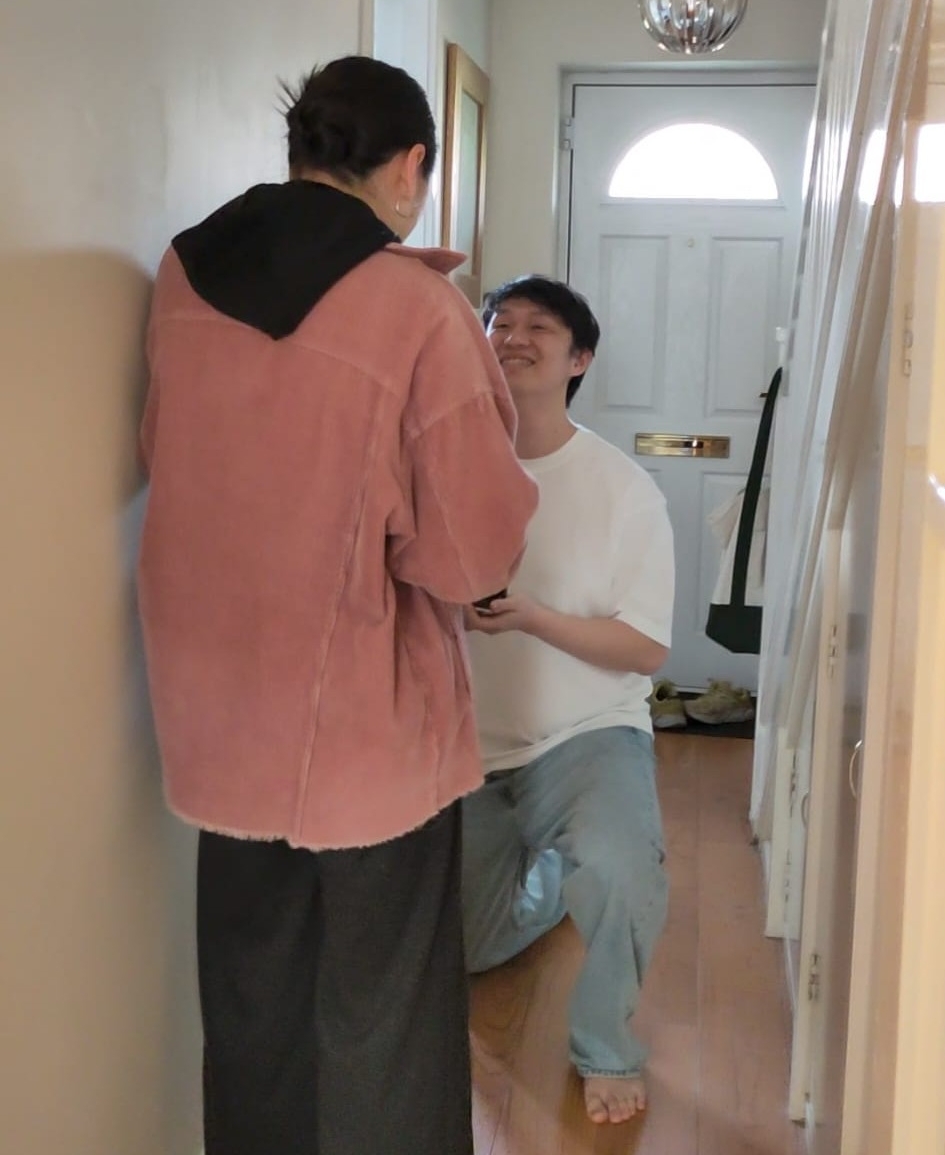
Anyway, it’s Easter weekend, which explains why I’m able to finally get this blog post out. I’ll write more soon.
I’m going to go and play some Dredge and Disco Elysium now. Check out this docuseries on the development of Disco, it’s excellent. Check out Vulfpeck, live at MSG for the second time. See ya.